ST Technology: Definition and Operating Principles
A soil solidifier is an engineering material formulated from a composite blend of various organic and inorganic substances or biological enzymes. Its core mechanism of action involves a series of complex physicochemical reactions that alter the surface charge properties of soil particles and compress the electrical double layer on their surfaces. This process effectively disrupts the adsorbed water films situated between soil particles, thereby facilitating the rapid formation of a stable skeletal structure by inorganic or organic cementing agents.
√ Ion Exchange
Converts the hydrophilic groups on the surface of soil particles into hydrophobic groups, thereby reducing water content.
√ Structural Formation
Promotes the rapid formation of a cementitious material framework, thereby filling the voids between soil particles.
√ Rapid Solidification
Rapidly and efficiently dewaters and solidifies materials such as soil, sand, and slag, forming a stable soil mass.
Wide Range of Application Scenarios
SST technology is well-suited for engineering projects with stringent requirements for cost control and rapid construction, and finds widespread application across a diverse range of infrastructure scenarios.
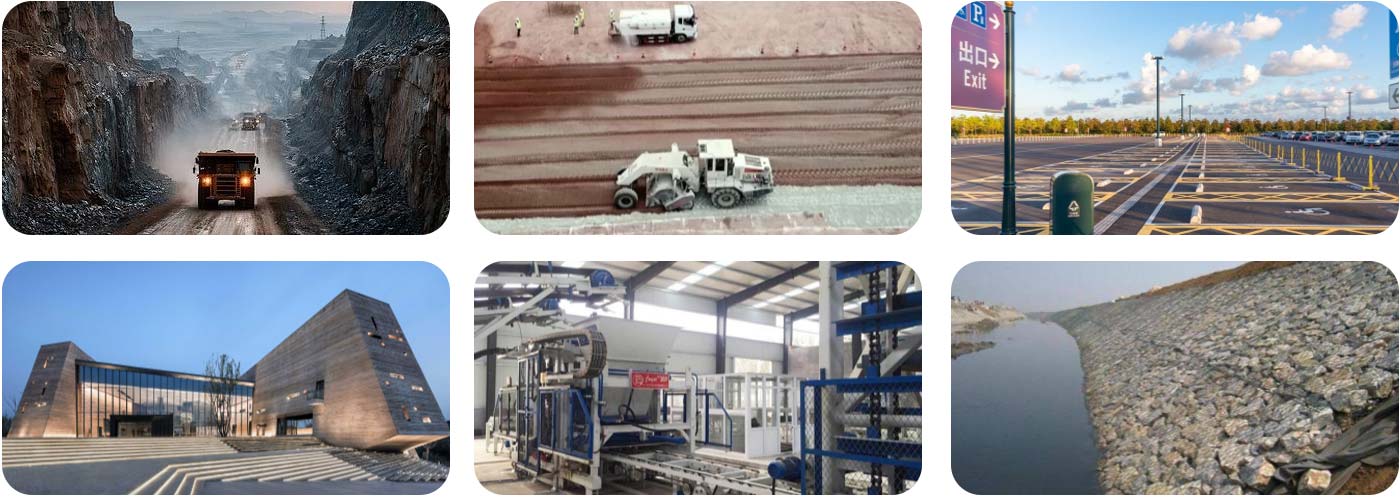
1. Construction of Lower-Grade Roads
· Industrial & Mining / Open-Pit Roads
· Withstands Heavy Loads
· Wear-Resistant & Durable
· Rural & Forestry Roads
· Utilizes Local Materials
· Adapts to Terrain
· Lower Cost
2. High-Grade Highway Structural Layers
· Pavement Base / Sub-base
· Load-bearing foundation for high-grade
· highways—stable and solid.
· Roadbed Embankment
· Soft foundation reinforcement & bridge abutment backfill – effectively controls settlement.
3. Site Paving
· Parking Lots / Freight Yards / Drying Grounds
· Enables rapid, large-scale surface hardening; features a robust base suitable for heavy vehicle traffic and cargo stacking.
4. Wall Construction and Repair
· Greenhouse wall & historic earthen structure restoration.
· Local soil rammed earth walls: thermal insulation and air permeability integrated.
5. Production of Non-fired
· Bricks and Imitation Stone Bricks
· Compress stabilized soil into unfired bricks.
· Recycle waste into value, save brick-making raw materials and cut energy consumption.
6. Slope and Seepage Control Engineering
· Stabilization of slopes and riverbanks; leachate containment for landfills.
· Enhances soil stability, improves resistance to erosion, and creates an impermeable barrier.
Comparison of Core Performance Advantages
Compared with traditional cement-stabilized soil, SST-type solidified soil demonstrates clear advantages in overall performance, making it better suited to withstand harsh operating conditions.
| Performance Indicator | SST-Type Stabilized Soil | Traditional Cement Stabilized Soil |
| 7-Day Compressive Strength | ≥ 2.5 MPa | ~ 2.0 MPa |
| Water Stability | ≥ 80% | ~ 70% |
| Frost Resistance | ≥ 80% | Poor |
| Shrinkage | Low | High |
| Strength | High | Low |
| Indicator | SST-Type Stabilized Soil Advantage |
| 7-Day Compressive Strength | SST offers higher early strength, allowing roadbeds to reach operational intensity sooner. |
| Water Stability | SST offers superior water resistance, making it suitable for humid and rainy regions. |
| Frost Resistance | SST exhibits excellent weather resistance and can be widely used in cold regions. |
| Shrinkage | SST effectively reduces pavement cracking, resulting in superior structural durability. |
| Strength | The SST curing reaction is rapid, enabling the quick development of strength. |